Navigating California’s Climate Disclosure Laws


🌍 Carbon markets can feel overwhelming—fragmented data, limited transparency, and conflicting advice make it hard to know where to start. In this webinar, our experts give a clear, practical introduction to the VCM.
How California’s new climate disclosure laws reshape corporate reporting and how to stay ahead through transparency, strategy, and smart carbon management.
California rewrote the rules of climate accountability. Companies that operate or sell in the state will soon see their emissions data scrutinized as closely as their financials. Through Senate Bills (SB) 253 and 261, and Assembly Bill (AB) 1305, the state has enacted the nation’s most ambitious climate disclosure laws, setting a new benchmark for verified, auditable, and transparent corporate reporting. Enacted in 2023, they are entering their first compliance phase starting in 2026. The California Air Resources Board (CARB) has already published a preliminary list identifying approximately 4,160 companies that may be subject to SB 253 and SB 261, signaling the sweeping reach of these regulations.
For decades, California has led the nation in environmental innovation, from fuel standards to clean energy mandates. Its latest move may be the most transformative yet: compelling organizations to reveal the full climate cost of their operations, investments, and supply chains. Together, these laws shift climate disclosure from a voluntary exercise in ESG reporting to a mandatory framework of verified, standardized accountability. By requiring third-party assurance and consistent reporting methodologies, California aims to make climate data as credible, comparable, and auditable as financial statements.
What Do the Rules Actually Mean?
California’s new climate disclosure laws are reshaping how large companies measure, manage, and communicate their climate impact, demanding a higher standard of accountability from the corporate sector. Here’s what these new laws mean for businesses and what you’ll need to prepare for:
SB 253: The Climate Corporate Data Accountability Act
California’s new emissions disclosure law, SB 253, will require large companies earning over $1 billion a year to publicly report their greenhouse gas emissions.
CARB has proposed the first reporting deadline for August 10, 2026, covering only Scope 1 and Scope 2 emissions in the first year. Everyone will get at least six months after their fiscal year ends to submit their report. If a company wasn’t collecting emissions data by the time the Enforcement Notice was issued (December 5th, 2024), there is no need to report emissions in 2026; simply submit a short statement saying reporting has not started yet.
Eligibility is based on tax-code definitions of revenue and doing business in California, and nonprofits or companies with only teleworkers in the state would be exempt.
Eventually companies will require Scope 3 reporting as well, which is often the most challenging category. Early preparation will make this transition smoother.
What can you do now?
Even though CARB has loosened some of the first-year requirements, it’s still important for companies to start preparing now. For 2026, limited assurance is not required, but companies can submit assurance if they already have it. CARB’s Scope 1–2 reporting template is optional, and companies may use any report format in the first year. CARB also clarified which fiscal year’s data to use: organizations with fiscal years ending Jan 1–Feb 1, 2026 will report FY26 data, while those ending after Feb 1 will report FY25 data.
These flexibilities give companies more breathing room, but they also create a strong incentive to begin organizing data, documenting methodologies, and identifying any gaps well ahead of the deadline. Early preparation will make the 2026 reporting process smoother and help ensure that companies are ready when assurance becomes required in future years.
SB 261 Climate Risk Disclosure
SB 261 shifts the focus from emissions to climate-related risk. Companies with over $500 million in annual revenue must assess and publicly disclose how climate change could affect their business, from supply chain volatility to market and regulatory pressures to physical climate impacts.
But as the first reporting deadline approached, the landscape became more complicated.
A Temporary Pause
As of November 2025, the U.S. Chamber of Commerce and business groups filed a First Amendment lawsuit challenging SB 261, and the Ninth Circuit granted an injunction. It’s an active legal challenge, importantly, this pause does not eliminate the rule; it simply delays implementation while litigation proceeds.
What can you do now?
Even with enforcement on hold, organizations can, and should, start building their climate-risk reporting foundation. CARB’s recently updated Climate Risk Report Checklist and FAQ emphasize a “progress over perfection” approach, giving companies flexibility as they start their reporting processes.
Companies can use best-available data, even if it comes from earlier fiscal years such as FY 23/24 or FY 24/25, and may provide qualitative scenario analysis where more sophisticated modeling isn’t possible yet. CARB encourages transparency around data gaps, limitations, and assumptions, and while industry-specific ISSB/IFRS guidance is recommended, it is not required. However, CARB recommends limited assurance for annual reports from 2026 through 2029, with reasonable assurance beginning in 2030.
CARB also clarified the SB 261 submission process: companies must publish their climate risk report on their website by the compliance deadline (previously January 1, 2026) and submit a link to the report in CARB’s public docket. The docket is scheduled to open December 1 and will remain accessible through July 1, 2026, ensuring transparency and comparability across industries once enforcement resumes.
That said, beyond compliance, conducting a robust climate-risk assessment and scenario analysis is a strategic advantage. It enables companies to better understand how climate-related factors could affect long-term performance, supports more resilient decision-making, and positions the organization for sustainable business success. While a best-faith effort may ultimately satisfy the first reporting cycle once SB 261 moves forward, investing in a comprehensive risk assessment will create far greater value by aligning climate risk management with overall business strategy.
AB 1305 Carbon Claims and Transparency
Already in effect, AB 1305 tightens the rules around “carbon neutral” or “net-zero” marketing claims. If your company buys carbon credits or offsets, you’ll need to disclose key details, like the project’s location, verification standard, and how permanent those reductions are.
Who’s Impacted?
These laws reach far beyond California’s borders. Any company doing business in the state and meeting the revenue thresholds (roughly $500 million to $1 billion+) falls within scope, regardless of where it’s headquartered.
This is just the beginning. California’s model is expected to influence federal policy and inspire similar frameworks across other states and countries.
Summary
| Law | Who It Applies To | Focus | Deadlines | What We Recommend |
| SB 253 – Climate Corporate Data Accountability Act | Companies with >$1B annual revenue | Greenhouse Gas (GHG) Emissions Disclosure (Scopes 1, 2, and 3) | 2026–2027 August 10th 2026. | Begin calculating FY2025 GHG data early (Q1 2026) to allow time for third-party assurance. Establish internal data collection systems and identify a qualified verifier. |
| SB 261 – Climate-Related Financial Risk Disclosure | Companies with >$500M annual revenue | Climate Risk Assessment and Disclosure | TBD | Develop a climate risk report aligned with the TCFD framework. Conduct scenario analysis to understand potential business impacts and integrate findings into strategic planning. |
| AB 1305 – Carbon Claims and Transparency Act | All companies making “carbon neutral,” “net-zero,” or similar claims | Transparency in Carbon Credit and Offset Reporting | In Effect | Audit all current climate-related marketing claims. Disclose details for carbon credits (location, verification, permanence) and ensure claims align with science-based targets and clear internal policies. |
The Bigger Picture: ESG and Transparency Trends
For years, sustainability reporting lived in the realm of marketing, voluntary, self-defined, and often unaudited. Then investors, regulators, and customers started asking a different question:
“Can we actually trust this data?”
That demand for trust transformed sustainability reporting. Today, data must be verifiable, comparable, and financially relevant. California’s new laws sit squarely at the center of this global shift toward accountable ESG performance.
This push for credibility isn’t limited to California.
In Europe, the Corporate Sustainability Reporting Directive (CSRD) aims to introduce standardized and verified ESG disclosures across thousands of companies, including non-EU firms doing business in the region.
Globally, the International Sustainability Standards Board (ISSB) has launched IFRS S2, a form of reporting framework aligned with TCFD, effectively defining the new international language of climate disclosure.
When you put these together, a clear pattern emerges of global markets are rewarding companies that treat climate data with the same rigor as financial data.
The good news? Companies that start preparing now for California’s new rules won’t just be checking one state’s compliance box. They’ll be building a foundation for global ESG requirements, positioning themselves ahead of competitors who wait for regulations to catch up.
Carbon Credits and Climate Claims: Why it matters more than ever
To be “carbon neutral” is a badge of honor, but today, it’s also a call for greater clarity, one that forward-thinking organizations are embracing head-on. California’s AB 1305 is the start of a new era of transparency, ensuring that every “carbon neutral,” “net zero,” or “climate positive” claim is backed by credible data. This accountability strengthens the voluntary carbon market, rewarding projects and companies that invest in high-quality, verifiable carbon credits that deliver real climate impact.
For years, companies could offset their emissions by purchasing carbon credits, often without much scrutiny over how those credits were generated. That’s changing and it’s a good thing. High-quality carbon credits remain one of the most effective tools for driving real, measurable climate impact, when chosen carefully. Projects like reforestation, regenerative agriculture, or renewable energy can help fund sustainable development while balancing unavoidable emissions.
Under AB 1305, California now requires companies to share detailed disclosures. That includes:
- Where the carbon credits come from (the project location and type.)
- How they’re independently verified
- What ensures their permanence and measurable impact.
- It separates credible, high-quality climate action from vague marketing language and builds a marketplace grounded in trust and accountability.
Transparency isn’t a burden, it’s a differentiator. That’s what today’s investors, customers, and regulators are looking for: climate leadership that’s credible, data-driven, and real.
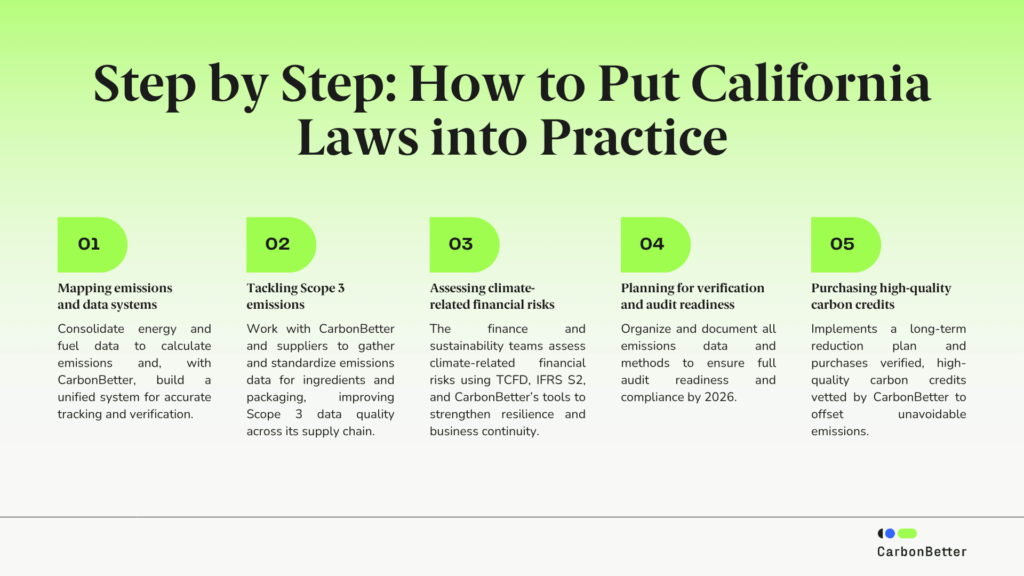
Step by step: How One Company Puts the Laws into Practice
Imagine Solara Foods, a $2 billion consumer goods company with operations across North America and major sales in California. With the state’s 2025 climate rules approaching, Solara must prepare for both emissions’ disclosure (SB 253) and climate risk reporting (SB 261).
Step 1: Mapping emissions and building data systems
Solara begins by pulling together energy and fuel data from all its plants and trucks to calculate Scope 1 and 2 emissions. Working with CarbonBetter and Solara’s internal sustainability and operations teams, the company builds a unified and reliable data system to track emissions and prepare for third-party verification.
Step 2: Tackling Scope 3 emissions
Most of Solara’s climate impact comes from its ingredients and packaging. The company engages key suppliers to collect emissions data and fills in gaps using estimates where needed. CarbonBetter supports Solara’s procurement and sustainability teams in designing a simple, consistent method for suppliers to share accurate emissions data, improving data quality across the value chain.
Step 3: Assessing climate-related financial risks
Solara’s finance team evaluates how droughts, rising energy costs, and material shortages could affect operations and profitability. Using frameworks like TCFD and IFRS S2, along with CarbonBetter’s Climate Risk Assessment, the teams identify the most significant risks and develop mitigation strategies that align climate resilience with business continuity.
Step 4: Planning for verification and audit readiness
Solara documents every data source and methodology now so that, by the time the 2026 audit arrives, every record is organized, accurate, and ready for third-party review. This proactive approach reduces the likelihood of costly delays or compliance issues later.
Step 5: Purchasing high-quality carbon credits
Solara commits to a multi-year emissions-reduction roadmap developed with CarbonBetter, while taking immediate steps to address unavoidable emissions. The company purchases verified, high-quality carbon credits from reforestation and regenerative farming projects—carefully vetted by CarbonBetter for both environmental integrity and community benefit.
The result:
By combining in-house expertise with CarbonBetter’s specialized guidance, Solara is fully prepared to comply with California’s new climate regulations while strengthening its overall sustainability strategy. This preparation not only reduces regulatory and reputational risk but also positions Solara as a forward-thinking leader in responsible business.
By openly sharing its progress and disclosing credible, transparent data, Solara builds trust with investors, customers, and regulators, creating goodwill and reinforcing its reputation for accountability. The company transforms compliance from a box-checking exercise into a competitive advantage, enhancing brand value, investor confidence, and long-term resilience.
How Carbonbetter Helps Businesses Lead
At CarbonBetter, we specialize in turning climate compliance into opportunity.
We help companies build ESG and carbon strategies that align with California’s new rules and global frameworks, implement robust systems for emissions tracking, supplier data, and audit preparation, verify and communicate carbon credit claims to avoid reputational risk, engage internal teams and suppliers to strengthen data collection and readiness, use transparency as a strength transforming compliance into a story of leadership and trust.
Our goal is to make climate strategy both achievable and valuable.
The Bottom Line: Compliance as a Catalyst
California’s climate laws aren’t just another set of regulations. They’re a signal that corporate transparency is the new standard of leadership.
By acting now, your company can do more than meet deadlines, you can strengthen brand trust, improve efficiency and attract investors who value credible climate action.
Partner with CarbonBetter to future-proof your compliance and climate strategy and lead confidently into this new era of corporate climate disclosure.
Contact us to learn how we can support your journey toward a low-carbon future. Let’s get started.
California enacted three major climate disclosure laws (SB 253, SB 261, and AB 1305) to increase corporate transparency on greenhouse gas (GHG) emissions, climate-related financial risks, and carbon credit claims. Together, these laws require large companies doing business in California to publicly disclose verified emissions data and climate risk assessments, and to back up any “carbon neutral” or “net-zero” claims with verifiable evidence.
Develop a high-level review of emissions estimates conducted by an independent third party. While the California Air Resources Board (CARB) has not yet specified the exact qualifications required for verifiers, our view is that any independent organization with demonstrated experience in greenhouse gas (GHG) accounting should be acceptable. Because third-party assurance typically takes four to six weeks, we recommend that companies complete their 2025 GHG estimations by Q1 or April 2026. Early preparation will allow sufficient time for verification, internal review, and adjustments, ensuring accuracy and readiness well before the compliance deadline.
If your company makes climate-related claims (e.g., “net-zero,” “carbon neutral,” “climate positive”), you must publicly disclose: The type and location of carbon credit projects, the verification standards used, and evidence of the permanence and impact of the offsets. This ensures transparency and builds trust with stakeholders.
CarbonBetter helps organizations measure and verify greenhouse gas (GHG) emissions, develop climate risk reports aligned with the Task Force on Climate-related Financial Disclosures (TCFD) framework, audit and validate carbon credit claims, and build robust data systems for ongoing compliance. By turning transparency into a competitive advantage, partnering with CarbonBetter ensures your business stays ahead of evolving climate disclosure regulations.
A recent (November 2025) court decision has temporarily paused enforcement of SB 261. However, the pause does not eliminate the law, it simply delays implementation until the legal process continues. SB 261 is a California law that requires companies with more than $500 million in annual revenue doing business in the state to publicly disclose how climate change could impact their business.
About the Authors

Pankaj Tanwar is Managing Director of Climate Services at CarbonBetter. He has experience leading Fortune 100 companies through their sustainability journeys, including sustainability driven growth in the food industry. Pankaj holds an MBA from Northwestern University’s Kellogg School of Management and a BTech in Mechanical Engineering from the Indian Institute of Technology, Kanpur.
From the Stories

CORSIA Carbon Credits: What Airlines Need to Know Before the 2027 Mandatory Phase
Understanding CORSIA eligibility, supply constraints, and sourcing strategy ahead of the scheme's mandatory phase.

Edition #16 | Your Sustainability Team’s Weekly Briefing
Welcome to your weekly sustainability briefing! We're covering three developments that are reshaping how businesses think about climate risk, carbon markets, and the politics of the green transition.

Looking Beyond Energy: The Next Test for Semiconductors is Sustainability.
Semiconductor companies face pressure to build the emissions data, supplier relationships, and clean energy strategy their customers and regulators will soon require.